Section 2.1 Learning and evaluation
Choose a learning regime
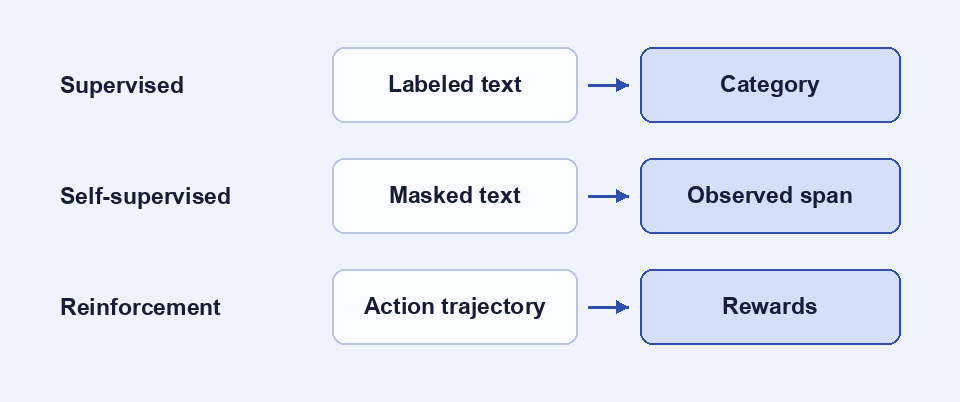
The desired result and the available training signal guide the method. When historical requests are associated with verified categories, supervised learning fits a function that predicts those categories. Its input features may be word counts, character segments or vectors from an encoder. The target definition and the availability of reliable labels matter as much as the algorithm.
Learning without direct annotation
Unsupervised clustering groups requests according to a representation and a distance measure. A group containing “registration” and “account” could reflect shared vocabulary, a temporary campaign or a common underlying problem. Someone has to interpret the clusters. In self-supervised learning, the target comes from the data itself. Mask a fragment and the original fragment becomes a prediction target without human labeling. Chapter 3 examines another form, next-token prediction.
Learning to act
In reinforcement learning, a policy selects actions based on observations. Actions may change the state and yield rewards, which can be delayed. A scheduler trained in simulation might aim to reduce total queue wait. A reward based on the number of closed requests could favor closing many simple cases while leaving complex ones waiting. Designing the reward and testing the simulator are therefore part of the problem.
Application. To discover types of requests missing from a category guide, start by reading a sample and examining similarities. To predict existing categories, assess annotation consistency. The two objectives call for different evidence.